

How did the electronic cigarette heating wire develop?
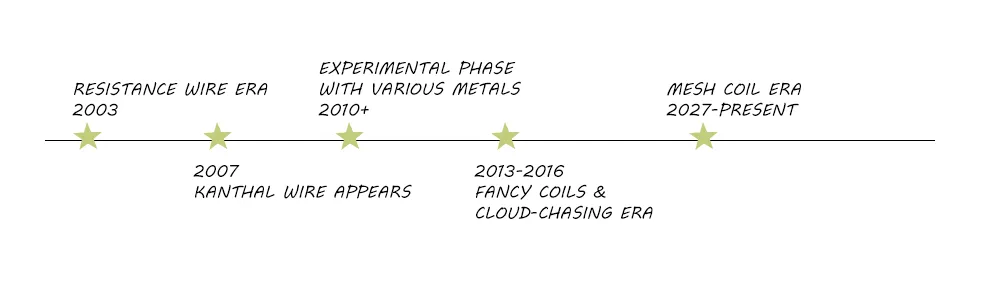
The development history of electronic cigarette heating wire
Electronic Cigarette Early Stage: Resistance Wire Era (around 2003)
When e-cigarettes were first invented, the heating element was just simple resistance wire (mainly Nichrome, NiCr).
The principle was like an electric kettle or stove: electricity flows → wire heats up → e-liquid evaporates.
The downside: uneven heating, easy to burn the liquid, and short lifespan.
Improvement: Kanthal Wire Appears (from 2007)
Later, people found that Kanthal wire (iron-chromium-aluminum alloy) was better.
High heat resistance, less oxidation, much longer lifespan than Nichrome.
It became the mainstream heating wire for atomizers, and DIY users could build their own coils.
Experimental Phase with Various Metals (after 2010)
As vaping became popular, manufacturers and users experimented with different materials:
Stainless Steel (SS): fast heating, usable in both temperature control and power modes.
Titanium (Ti): even heating, but oxidizes too easily, raising safety concerns.
Nickel (Ni200): great for temperature control, but very low resistance and hard to work with.
👉 This stage was about exploring “which material works best.”
Fancy Coils & Cloud-Chasing Era (2013–2016)
With more DIY enthusiasts, many “fancy coils” appeared:
Clapton coils: like guitar strings, thick and thin wires wrapped together → bigger surface area → more vapor and richer flavor.
Other designs like Alien, Fused Clapton, hybrid Mesh coils, etc.
The trend of this period was “cloud chasing” — high-power devices with complex coils for huge vapor.
Mesh Coil Era (2017 – Present)
Later, people realized:
Fancy coils are fun but consume more power and e-liquid, and can be unstable.
Mesh coils (thin metal sheets) became popular:
More even heating, less chance of burning.
Smoother flavor and longer lifespan.
Perfect for disposable vapes and modern atomizers.
Now, most disposables and many pod systems use Mesh coils.
✅ In summary:
The evolution of vape coils went from resistance wire → Kanthal → various metals → fancy coils → Mesh.
Just like phones evolved from “Nokia button phones” to “smartphones,” vape coils evolved from “just working” to “better taste, more stable, and safer.”